Tuesday, April 5, 2011

The End of An Era

In January 2005, Richard M. Kessel, chairman of the Long Island Power Authority held a ceremony at the decommissioned Shoreham nuclear power plant and said:

''We stand in the shadow of a modern-day Stonehenge, a multibillion-dollar monument to a failed energy policy, to formally commission the operation of a renewable energy technology that will harness the power of the wind for the benefit of Long Island's environment.''

Although, it was only able to generate electricity to power 25 homes per day, that moment would symbolise the beginning of the end of an era of nuclear power.

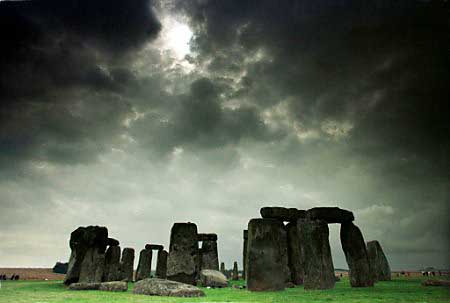
Stonehenge, built approx. 3000 B.C., England


There is something atavistic about monuments. As if entombed in stone, they were somehow immortalised for generations to witness their terrible beauty.

Fukushima nuclear power plant, built in 1971, Japan

Scholars have theorised that Stonehenge was a burial area, where the living dead were put to rest. In a similar vein, the Fukushima nuclear reactors will be entombed in concrete; the deceased people who might lay nearby, unable to be retrieved due to radioactive poisoning. When encompassed in concrete, the Fukushima nuclear power plants will be a no-living zone, where for centuries, the radioactive plutonium, celesium and iodine will make the once fertile land a kind of burial space.

Stonehenge map

Fukushima II nuclear power plant

Once entombed in concrete, Fukushima will be a city turned to stone, a monument to a nuclear Medusa that had perfectly captured its beauty, like a crushed butterfly encased in a horrific display.


Where Stonehenge stands now, the land is lush again and eccentrically green. We still ponder why for hundreds of centuries, the surrounding land had been a no-living zone. All we can surmise is that life did not exist around 1500 B.C., some 1500 years after Stonehenge had been built. Anthropologists and scholars extrapolate that there were periods in our earth's history where massive extinctions of complex life occurred for unknown reasons.

The heretical question remains then, in our contemporary era, will our dependence on nuclear power eventually destroy us in the end?

(Disclosure: I do not hold any positions in stocks that power nuclear energy such as EXC, ETR, D and GE)

Wednesday, March 30, 2011

Why Libya hates Japan

When I talk to my friends who have holdings, options and futures positions in energy stocks, mainly those of crude oil, and the petroleum sector, they all say the same thing: that oil reigns supreme and the countries and corporations that have dominated the global economy with our co-dependence on oil has lead some companies to rise in stock within these uncertain times. Saint Mary Land & Exploration (SM) Chevron (CVX), Tesoro (TSO), Exxon (XOM), Range Resources Group (RRC), Conoco Phillips (COP) are all well run companies. They have established their mighty place in the world. They give people what we need, energy. We love our cars, and cars are run on oil.

The country that has benefited the most, of course, is Libya. Libya is the crack dealer who sells oil to the rest of the world. Their sweetest variety of oil is their largest export, and accounts for more than half of their revenue. The GDP per capita of Libya soared by 676% in the 1960s and a further 480% in the 1970s thanks to oil.  

Libya's natural resource allows the Gaddafis to afford expensive palaces, real estate in foreign countries and a world-class education while the rest of their population live in near poverty. The average Libyan does not have access to a world class education; much of their industry simply revolves around the oil industry.

Japan, by comparison is a wealthy nation that is built upon technological innovation and prowess, similar to the United States and Switzerland. Education is valued by the Japanese. Their main religion, the Shinto religion, is one in which they are one with nature. They created and initiated the Kyoto Treaty, one in which would've made our planet a cleaner and more beautiful place. So, how cruel of a fate is it that the world's leader in clean energy would suffer a tripartite of the worst geophysical disaster ever, in which, not only did they suffer a 9.0 earthquake, but was followed by a tsunami and then a volcanic eruption?

The beauty of Japan, and their love of nature and clean energy was taken away in just one week.


People might ask why? Was it some act of nature? Why did this happen to a country that was the innovator in clean energy?

Let's examine the chronology:

Japan was the first to utilise algae biofuel in commercial airline flights in 2008. They no longer use oil to fuel for airplanes. They want to move away from the world's dependence on oil. By some act of genius, they figured out how to create sustainable energy out of seaweed, and somehow convinced the United States to try it too, so that our US NAVY is fuelled not by the petroleum or natural gas, coal or the oil sector but by algae biofuel, a technology that Japan freely shared with us to the extent that Honeywell (HON) and Exxon (XOM) are also in research and development of the multiple uses of algae biofuel. But that wasn't enough, they somehow also figured out how to power cars by using water in 2008 (Genepax) before MIT researchers figured out the same thing in 2011 to power houses, using the same principle.

What would happen if Japan went into global mass production with these water powered cars?

Libya would no longer have a dependable revenue on exporting oil. They are a nation built upon one thing, and that thing they hold most valuable would not be necessary any longer in global economics.

However, all our great oil companies in the United States would also go bankrupt. Our economy might fall further into recession. The bull run would end. CVX, TSO, SM, COP, RRC, XOM would no longer have a demographic.  These are great companies, and somehow we must find a way for them to transition into our brave new world. When coal was the primary source of energy in America in the 1800s, an American entrepreneur, John D. Rockefeller created the Standard Oil Company, that would later become Exxon Mobil; because he believed oil, and not coal, was the future, despite many protestations of disbelief and doubt coming from the coal industry and the general public.

We seem to be at a similar juncture in time, when there is a changing of the guard. Who will take John D. Rockefeller's place?

Brave New World

That's great, it starts with an earthquake, birds and snakes,
an aeroplane - Lenny Bruce is not afraid.
Eye of a hurricane, listen to yourself churn,
world serves its own needs, dummy serve your own needs.
Feed it off an aux speak, grunt, no, strength,
The ladder starts to clatter with fear fight down height.
Wire in a fire, representing seven games, a government for hire and a combat site.


-R.E.M., "It's the end of the world (and I feel fine)"

Who would've thought that the incoherent ramblings of a pop song could have such chilling relevance to world events? Let's examine the modern chronology of events:

Thousands of birds suddenly dying and falling from the sky in Arkansas, Louisiana and also Sweden. (Jan 1-4 2011)


Millions of fish washing up dead in Cheasapeake Bay, Maryland (Jan 4 2011)


Another million sardines found dead in Redondo Beach, CA (March 8 2011)


Earthquake and tsunami in Japan (March 11 2011)


Cobra missing from the New York Zoo (March 23 2011) 


What is clear is that these aren't natural occurring phenomena. There is something strangely correlated about these series of events. 


"The key to geophysical warfare is the identification of environmental instabilities to which the addition of a small amount of energy would release vastly greater amounts of energy. "

-Professor Gordon J. F. MacDonald was associate director of the Institute of Geophysics and Planetary Physics at the University of California, Los Angeles, was a member of the President's Science Advisory Committee, and later a member of the President's Council on Environmental Quality in 1966. (from Angels Don't Play This HAARP: Advances in Tesla Technology, 1995)

HAARP is High Frequency Active Auroral Research Program. It utilises ELF waves to target the earth’s crust and specified populations can be negatively afflicted by geophysical phenomena, such as earthquakes, tsunamis and volcanoes, in addition to mind control, brain-wave interference, and can lead to the influence of targeted electro-magnetic fields that most probably leads to ill health, but also to death in plants, humans, and of course, animals. In other words, the World Wars of the past can now be replaced with geophysical warfare.

Except that with a blink of an eye, we can wipe out their population, and kill all living beings, using nature as our weapon of destruction.

Which countries have access to HAARP technology? All of us. 

Tuesday, February 15, 2011

The personality of a bull

I have to admit, I really have little to no respect for scalpers. I view scalpers as the scavengers of society, those animals that must feed off the remains of others or else, look for the uneaten pieces of food that others have left behind. They are the ones who would readily accept sloppy leftovers, cheat on their wives and husbands with their  wives and husbands'  best friends, and never contribute anything meaningful to society except to look for opportunities into benefiting from someone else's misfortune.

There is a psychology to scalpers- which is dog-eat-dog world which I never took to heart. Why would I sell 100K shares of a stock I hoped would fail then buy it back 2 cents later?

I suppose at heart, I prefer to watch those equities when they fail, I never short them in options for obvious reasons. In options, it is much easier to be bullish on particular stocks. Buying and selling puts were for losers. People who accumulated a lot of puts were basically people who decided that a stock was at a long term high, and then short them. They were short term thinkers, these people who believed 2008 should be a recurring year every year because they liked it when companies failed.

Scalpers were men who typically didn't care now know much about the stock they were shorting or buying at all, they only cared about the 1 cent. They were Wall Street's hangers-on and leeches; but thanks to algorithms, they were now replaced by automated programmes that would buy at the bid and sell at the ask.


And ironically scalpers' stories were all the same: They eventually burnt out; blew through their accounts, were addicted to meth and adderall, and decided to either go traveling around the world on a boat or go into real estate.

What is nice about options, is that one has options. Like a potential lover, you choose which ones catch your mind's eye, and then you strategically think of a way to seduce them. When they're pulling back, or at a dip, is when you go in for the kill. Or else, you make love to them while they're in consolidation mode, and then analyse them for short term or long term. Is this who I want to be in a short term or long term relationship with? The numbers by themselves, are for fools. The potential for a beautiful long-term relationship was always in the fundamentals and the technical charts of a particular equity.

I fell in love with AAPL because it made beautiful, efficient, machines that were pleasing both to the eye and to the wider demographic. I fell in love with CMG & WFMI because people wanted to be healthy and eat well; I fell in love with TIF because young men will always want to woo women with beautiful shiny things. With options, you never really had to buy the stock, you simply rode on its bullish trend, then exited, simply without putting in much risk aside from your premium. That was the beauty of long calls on options. You saw a talented person you could fall in love with, made a bet that this person would be successful, then simply banked on it before the expiry of your options contract. You never lost more than what you initially put in as your downpayment, but the rewards of that relationship were far more bountiful, if you set your eyes on someone whom you found worthy of your attentions.

You weren't actively looking for failures, which could be costly in options, and your losses unlimited, you were looking for successes.

Men who were bulls had entrepreneurial spirit. Men who were bears were looking for a quick buck.

In options, buying long puts were for losers who were looking for losers. But why focus on the negative? We were in a bull market in this year 2011. Why not simply capitalise on it?

Friday, February 4, 2011

The Emperor's New Clothes

There are two aphorisms one should consider when working in finance:

"Money is the root of all evil."
"A lack of money is the root of all evil."

Perhaps these seemingly opposing views are really complementary, such as Epictetus ' virtue in self-discipline and acceptance in living simply, not being ruled by one's lack of control of events; and Epicurius' discovery of  pleasure in the simple things in life and the fulfillment of one's duty. The definitions of stoicism and epicureanism have become perverted throughout the ages to refer to ideals that were the polar opposites, but at their inception, their views of the world were altogether rather similar.

So now we have come to a point in our history which represents the changing of the guard, when we must redefine ideologies once again.

In our society, the greatest virtue is to be "rich"; to amass great wealth, to have the kind of freedom and power which money can only bring. We worship not deities, nor ourselves, any longer, but in money. In Money We Trust. Wall Street is our religion, it is the powerful entity in which we bow down, and are envious of its all-encompassing power. No one cared about nobility any longer or the sacrifices made by the creative force in our society. Money was the one thing people would always admire.

Since we worship money, we must then examine how money is created, and how the illusion of money creates more money.

Let's take for example, Enron, a company that for decades defrauded their investors by fabricating positive gains in their accounting department. People believed the hype of Enron to the degree that 65 billion was lost in a company that was quietly losing money year after year, while their company executives happily spent their investors' money on company jets and posh offices. This house of cards came down when it was revealed that indeed, Enron had defrauded the best on Wall Street; 65 billion dollars of investor money, lost.

But we have not yet learned our lesson. The second ponzi scheme infamous in the media, Madoff's evil, ingenius and brilliant scheme came by the way of 60 more billion dollars; this time using his pristine Wall Street reputation to defraud the clientele of the elite upper class with JP Morgan as his ally. Perhaps in prison, where Madoff is now, he might be known as Robin Hood, who stole from the rich, a kind of hero to thugs and murderers who believe that the middle and upper classes in America should be made to suffer the fate of con-artists. Still, our lesson was not over yet.

And then, came Facebook, evaluated recently at 40 billion and climbing. The problem with social media was that, of course, it never created any revenue. Facebook was a liability to most investors; it sucked up funds, but never made a dime. Then Bill Gates, the evil, brilliant genius of all time, came to publicly bid Facebook for 6 billion dollars. This shocked the venture capitalist world. No one wanted to buy Facebook for less than 5 million by previous companies, but here, Mr. Gates set a precedent by publicising his intent to purchase the company for 6 billion, a feat in which he probably never intended to do in the first place, but as Microsoft was already an investor in the company, wanted to raise its value in the public eye. In the 4 years it has done so, Facebook is now theoretically worth 8 times that initial bid.

Was Facebook worth 6-40 billion, when it had negative cash flow every year? So our dilemma continues. However, Gates was able to elevate Facebook from being perceived as a liability to a company that was now, an asset. He proselytized the Silicon Valley masses into donating their flesh and blood into the religion of the Church of Facebook. If he wanted the company for 6 billion, certainly, it was worth more than that now, investors were saying, impressed by the imaginary messiah clothes that Mark Zuckerberg wore. Indeed, it was the revenge of the nerds. Somehow, they were able to fool all the Silicon Valley venture capitalists into thinking this company with negative cash flow was somehow worth at least 6 billion.

But let us continue. Now Hollywood, then picked up on this ponzi scheme, except they idolised it within the context of a Don Quijote movie, full of clichés, deifying Zuckerberg into some sort of cool Geek status in which his ordinary self is immortalised as a kind of archetype of the New American Hero. Here was  this likable nerd, socially inept and dorky, but cool, who steals an idea, makes a match.com site for Harvard students and becomes a billionaire. And he didn't even have to finish college.

But let's go back to the facts. Mark Zuckerberg might not be that cool guy in the movie; perhaps in real life, he was not a lovable nerd, but perhaps he sounded more like a conservative right bigot who had imbibed the politicial ideologies of half-informed posts on twitter, and sounded like illiterate college dropout he was. Who really knew?

The fact was, Zuckerberg, was smiling, perhaps with a contemptuous, comfortable smug on his geeky handsome visage, because he had pulled the biggest heist of all; more so than Enron, and Madoff, because Facebook was only profitable as long as investors poured in their money on a negative revenue company (especially with the help of Goldman Sachs, whose own executives wouldn't touch the Facebook stock but tried to push it onto all their European clients) but because in the process, the dorky Zuckerberg came off as some kind of cool hero for the population to be enamoured of.

The dorks shall inherit the earth, indeed.

Friday, January 28, 2011

The road less travelled

I was given the worst possible advice by our best options trader a few days ago. Suffice to say, he is brilliant in his own way, soft-spoken with a keen attention to detail in his exquisite scalping strategies in which he makes over 1000 trades per day.

This talented scalper, let's call him Kareem Abdul-Jabbar, after the basketball star; Kareem said to me that to be a great trader one had to fail and lose a lot of money. That is, to feel that pain of the loss of capital, to understand that agony in which one couldn't sleep at night because one was drowning in negative capital.

I didn't need to feel that agony. For the last half decade, I witnessed the decline of my family's fortune, as their multi-million dollar investments turned into dust. I stood witness, while my parents dutifully shielded me from that loss of capital. The future looked bleak, but my family never lost their perserverance. It's something that I never discussed, this economic tragedy that had befallen the members of my family, who for decades had enjoyed the American Dream.

It made me realise that women are often shielded from fiduciary matters. We are absent when business is discussed. As children, we learn that is it vulgar to discuss money with others; and we are sent on our way, to primp and preen, and be admired for our beauty and diligence, but are never consulted when important decisions are made regarding our financial future.

Middle class families send their daughters to become accountants and lawyers, in the hopes that they will never suffer the fate of an unknown financial future. I studied music and art, and in the United States, that is a privilege as I have come to learn. I look at all my artist friends, and most of them ahead of their time, the Picassos, Klimts and Van Goghs of their time, except no one knew who they were yet. Yes, we were all struggling.

So my brilliant co-worker, the star options trader continues to tell me that my non financial background could be a great asset; after all, my mind wasn't filled with superfluous information, and my particular style of visual thinking lead to an eerie accuracy in creating charts that always met their targets. But perhaps, underneath it all, I always had a love affair with the world's economy.

For me, failure wasn't an option.

Monday, January 17, 2011

Neocapitalism: An insular education

It's been said that Wall Street steals all the most brilliant people away to work in finance. When I ask people who work in all sectors of finance, they all seem to have the same story: Graduated from an Ivy League; majored in economics or accounting; interned at some bank as students, always knew they were going to work in finance etc. They studied numbers all their lives. They had parents who pressurised them into the field. They were following a path that was already paved from them. They never knew anything else.

I sometimes wonder if insider trading is really about people who socialise at country clubs, playing golf, and saying, hey, let's do this next week, just between you and me. Just don't leave a trail of emails, facebook messages, or twitters. You'll be fine, right?

I once read that the best traders are star athletes. Most investment and capital groups are attracted to star athletes, not due to their Michelangelo and model-like appearance, but because as star athletes, they are disciplined. They get up at the crack of dawn, they practice their technique daily, they don't indulge in excess, they learn to persevere etc. It's akin to the myth of the hero: this perfect athlete/ trader. They are Greek gods, admired by men and ladies alike, wanted by all Proprietary Trading Groups and bring in the most revenue.

The truth is, this probably is untrue- at least for most Proprietary Trading Companies out there. At our company, 3 of our best intraday traders were not athletes. They didn't even play sports at all. One was a warm, caring individual who came from a foreign exchange background, and studied business administration when he really wanted to be a writer. The other two, foreign immigrants who liked to play a lot of video games in their spare time, and the other still, a French national who read a lot of literature, and had an intuitive way of analysing the market. They knew how to scalp based on their understanding of routes, tape reading and learning how to outsmart the automatons at the "big banks" at intraday play. They were never A-students, and none of them attended Ivy Leagues nor were star athletes; but what they had in common was that trading was never meant to be their primary profession. Trading was their Plan B, and somehow, they found they were extremely good at it.


Did Wall Street take away our best scientists, artists, musicians, writers, engineers, editors, lawyers, doctors and make them into financial analysts, traders and investment bankers?

Perhaps. In the United States, we live under neocapitalism. One could no longer have the freedom to do what they wanted in life unless they were somehow involved with the financial market. 

Wall Street was our new religion. But part of the joy was discovering that path itself. This is what always separated the bulls from the bears. One had to always take a stand.